By Mubin Shaikh | Ads With Mubin
Most online stores in Dubai don’t fail because of the design. They fail because of things nobody planned before the build started.
The payment gateway takes six weeks to approve. Cash on delivery wasn’t set up, so half the orders never happen. Delivery charges don’t match what the courier actually bills. Product pages have no descriptions Google can rank. The store launches, the owner runs a few Instagram ads, and the sales just don’t come.
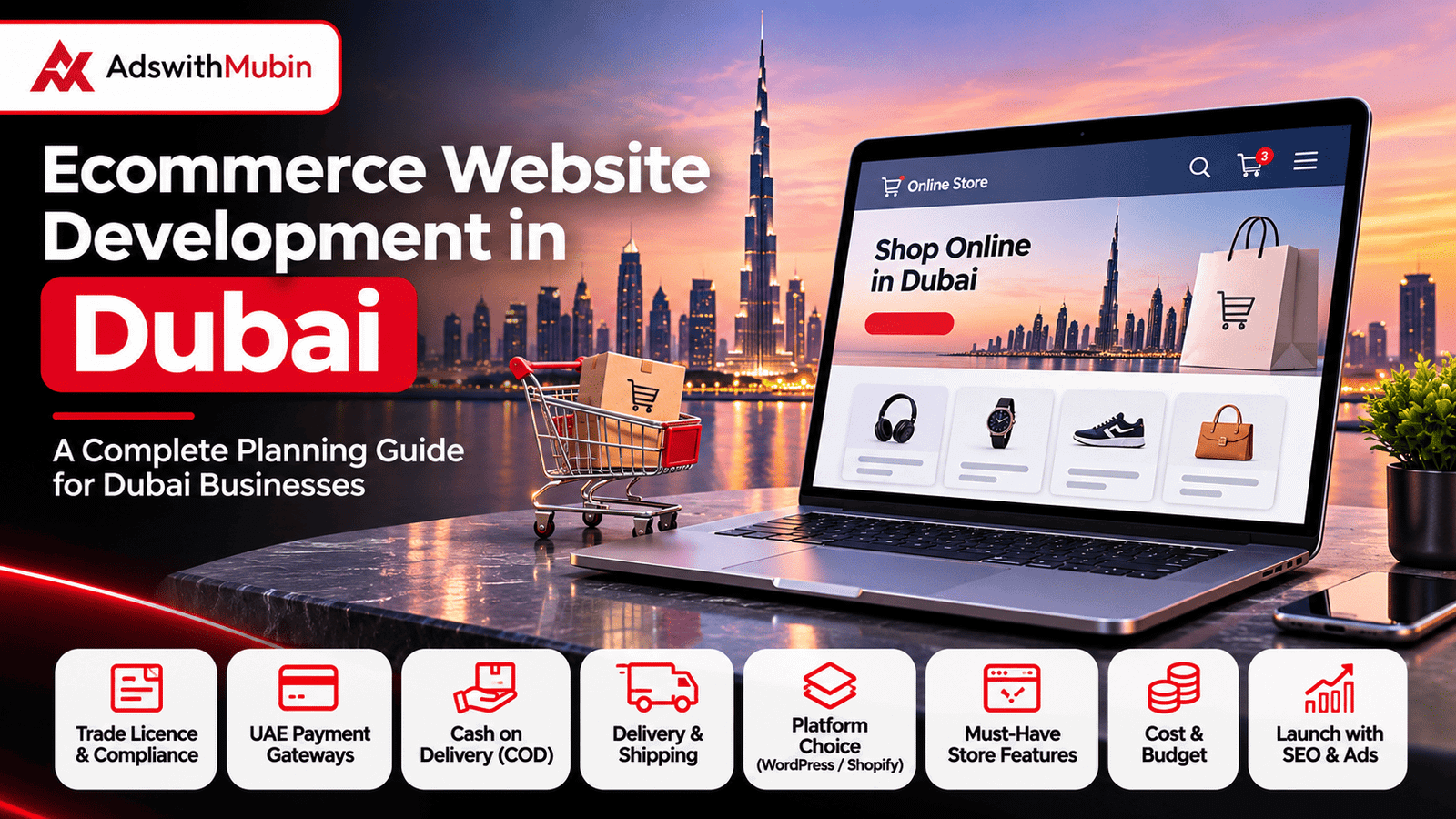
I build WordPress and WooCommerce stores for Dubai businesses, and I run the Google Ads, Meta Ads and SEO that bring traffic to them. This guide covers what you need to sort out before ecommerce website development in Dubai starts, what your store needs to sell properly, and how to launch it so it actually brings in orders.
Step 1: Sort Out the Business Side First
Before a single page is designed, check these. They take longer than the build itself.
Your trade licence
Your licence needs to cover selling online. Payment gateways will ask for it during approval, and so will some delivery partners. If your current licence only covers a physical shop or trading, check with your licensing authority whether you need to add an ecommerce activity.
A business bank account
Payouts from your payment gateway go to a business account in your company’s name. Some gateways also prefer certain banks or need specific documents.
VAT
If your business is VAT registered, your store needs to show prices correctly and issue proper tax invoices. Set this up during the build, not after your first sale.
Your returns and refund policy
UAE shoppers expect clear policies. Payment gateways usually require visible terms, privacy, refund and delivery policies on your site before they approve you.
Step 2: Choose Your Payment Options Early
This is the step that delays the most launches in Dubai. Start the payment gateway application as early as possible, ideally while the store is being designed.
Common options for UAE stores include:
- Card payment gateways: your bank’s own gateway, or providers like Telr, Network International, Stripe, Checkout.com and PayTabs
- Apple Pay and Google Pay: increasingly expected, especially on mobile
- Buy now, pay later: Tabby and Tamara are popular in the UAE and can lift order values
- Cash on delivery: still used by many UAE shoppers, especially for first orders
When comparing gateways, ask about setup fees, transaction fees, payout times, refund handling and whether they integrate with your chosen platform.
A tip on cash on delivery: it can increase orders, but it also increases returns and refused deliveries. Many stores offer it with a small fee or only for orders under a certain amount.
Step 3: Plan Delivery and Shipping
Delivery shapes the customer experience more than most store owners expect.
Decide:
- Which areas you deliver to: Dubai only, all of UAE, or GCC
- Delivery partner: your own drivers, a local courier or a larger shipping company
- Delivery charges: flat rate, free above a certain amount, or by emirate
- Delivery times: same-day, next-day or standard, and what you can actually promise
- Returns: who collects, who pays and how quickly refunds happen
Make sure the rates set up on your website match what your courier actually charges you. A mismatch quietly eats your margins on every order.
Step 4: Choose the Right Platform
For most Dubai stores, the choice comes down to two options.
WooCommerce (WordPress) gives you full control, no platform subscription, strong SEO and flexibility for custom features. It suits stores that also need a lot of content, custom functionality or full ownership.
Shopify is quick to launch, easy to run and handles hosting and security for you. It suits product-focused stores without a technical person on the team, though apps and plan fees add up.
I compared both in detail in WordPress vs Shopify for Dubai businesses. Whichever you choose, check that your preferred payment gateway and delivery partner integrate with it before you commit.
Step 5: Features Your Store Needs to Sell
Must-haves
- Fast, mobile-first design. Most UAE shoppers browse on their phones.
- Clear product pages with real photos, sizes or variants, prices, stock status and delivery information.
- Simple checkout. Guest checkout, as few fields as possible and the payment methods people expect.
- Search and filters, so customers find products quickly.
- WhatsApp button. Many Dubai shoppers want to ask a question before ordering.
- Order notifications by email, and ideally WhatsApp or SMS.
- Reviews on product pages.
- Clear policies for delivery, returns and refunds.
Worth adding as you grow
- Arabic version of the store
- Abandoned cart emails or WhatsApp reminders
- Discount codes and seasonal offers
- Loyalty or referral programmes
- Product bundles
- Inventory or accounting system integration
- Subscriptions for repeat-purchase products
Don’t try to launch with everything. Get the must-haves working properly, then add features based on what your customers actually ask for.
Step 6: Product Content That Sells and Ranks
Product content is where most Dubai stores cut corners, and it costs them both sales and Google rankings.
- Write your own product descriptions. Copying the supplier’s text means you’re competing with every other store using the same words.
- Use real product photos, from several angles, with a clean background and lifestyle shots where possible. Professional product photography often pays for itself quickly.
- Add the details shoppers ask about: size, material, ingredients, dimensions, warranty, care instructions.
- Organise categories logically, the way customers think about your products, not how your warehouse stores them.
- Give each category page its own description, since category pages often rank better than individual products.
Step 7: Build SEO In From the Start
An online store with poor SEO depends entirely on paid ads for every sale. That gets expensive.
During the build, make sure you have:
- Clean URLs for products and categories
- Unique titles and meta descriptions
- Product schema, so Google can show price, stock and reviews in search results
- Compressed images and fast page speed
- Proper handling of product variants and out-of-stock items
- A blog or guides section for buying-advice content
My SEO cost guide explains what ongoing SEO for a store usually involves.
Step 8: Set Up Tracking Before Launch
You’ll want to know which ads, products and channels are actually making money. Before launch, set up:
- Google Analytics 4 with ecommerce tracking
- Google Tag Manager
- Meta Pixel and Conversions API
- Google Ads conversion tracking
- Product feeds for Google Merchant Center and Meta catalogue
Without this, you can’t run Shopping campaigns or retarget people who viewed products, and you can’t tell which ads are profitable.
How Much Does Ecommerce Website Development Cost in Dubai?
It depends on the number of products, the platform, how custom the design is, which integrations you need and whether content and photography are included. A small store with a few dozen products is a very different project from a large catalogue connected to inventory and accounting systems.
Published Dubai pricing guides put ecommerce websites anywhere from around AED 5,500 to well over AED 100,000. My guide on website development cost in Dubai breaks down what pushes the price up or down.
Also budget for ongoing costs: hosting, payment gateway fees, plugin or app subscriptions, delivery, and marketing to bring in your first customers.
How Long Does It Take?
A small, well-prepared store can go live in a few weeks. Larger stores with many products, custom features or Arabic versions take longer.
The usual delays are payment gateway approval, product content and photos not being ready, and late changes to delivery or pricing. Starting those early keeps the project on track.
Launching Your Store: How to Get the First Orders
A new store has no traffic on day one. Plan how customers will find you:
- Google Shopping and Performance Max for people searching for your products
- Meta Ads on Instagram and Facebook for visual products and new demand
- Retargeting for people who viewed products but didn’t buy
- SEO for long-term, lower-cost traffic
- WhatsApp and email for repeat customers
For ecommerce, I generally recommend around USD 5,000 a month in ad spend to give campaigns enough purchase data to optimise properly. With less, focus on your best-selling products and one channel first. My guides on Google Ads cost and Meta Ads cost in Dubai go deeper.
Common Ecommerce Mistakes in Dubai
- Applying for a payment gateway after the store is built
- No cash on delivery, or COD with no limits
- Delivery charges that don’t match real courier costs
- Supplier product descriptions copied word for word
- Poor-quality product photos
- Long, complicated checkout
- No WhatsApp option for questions
- No tracking or product feeds at launch
- Launching with no marketing plan
Frequently Asked Questions
What do I need to start an ecommerce website in Dubai?
A trade licence that covers online selling, a business bank account, a payment gateway, a delivery partner, clear store policies, product content and a platform such as WooCommerce or Shopify.
Which payment gateway is best for UAE online stores?
It depends on your bank, platform, product type and fees. Compare a few options on setup costs, transaction fees, payout times and integration with your store before choosing.
Should I offer cash on delivery?
Many UAE shoppers still expect it, especially for first orders. Offering it can increase sales, but consider limits or a small fee to reduce refused deliveries.
Is WooCommerce or Shopify better for a Dubai online store?
WooCommerce gives more control, flexibility and no platform fee. Shopify is quicker to launch and easier to manage day to day. The right choice depends on your products, budget and who will run the store.
How long does it take to build an ecommerce website?
A small, well-prepared store can launch in a few weeks. Larger stores and those needing Arabic versions or custom integrations take longer.
Can you help market my store after launch?
Yes. I set up Google Shopping, Meta Ads, retargeting and SEO for online stores, with tracking built in from the start.
Planning an Online Store in Dubai?
The best time to get your ecommerce setup right is before the build starts.
Send me a message with what you sell, roughly how many products you have and where you want to deliver. I’ll tell you which platform I’d recommend, what you need to prepare and what it would cost to build, whether you work with me or not.
Explore my website development services in Dubai
Call / WhatsApp: +971 52 770 7860
Email: info@adswithmubin.com
Website: https://adswithmubin.com/