By Mubin Shaikh | Ads With Mubin
“Should I build on WordPress or Shopify?”
It’s one of the first questions Dubai business owners ask me before a new website. And it matters, because switching platforms later means rebuilding pages, moving products, redirecting URLs and often losing time and rankings along the way.
The honest answer: neither is better across the board. They’re built for different jobs. Shopify is a dedicated ecommerce platform. WordPress is a flexible website system that can run an online store through WooCommerce, but also handles service businesses, content and lead generation extremely well.
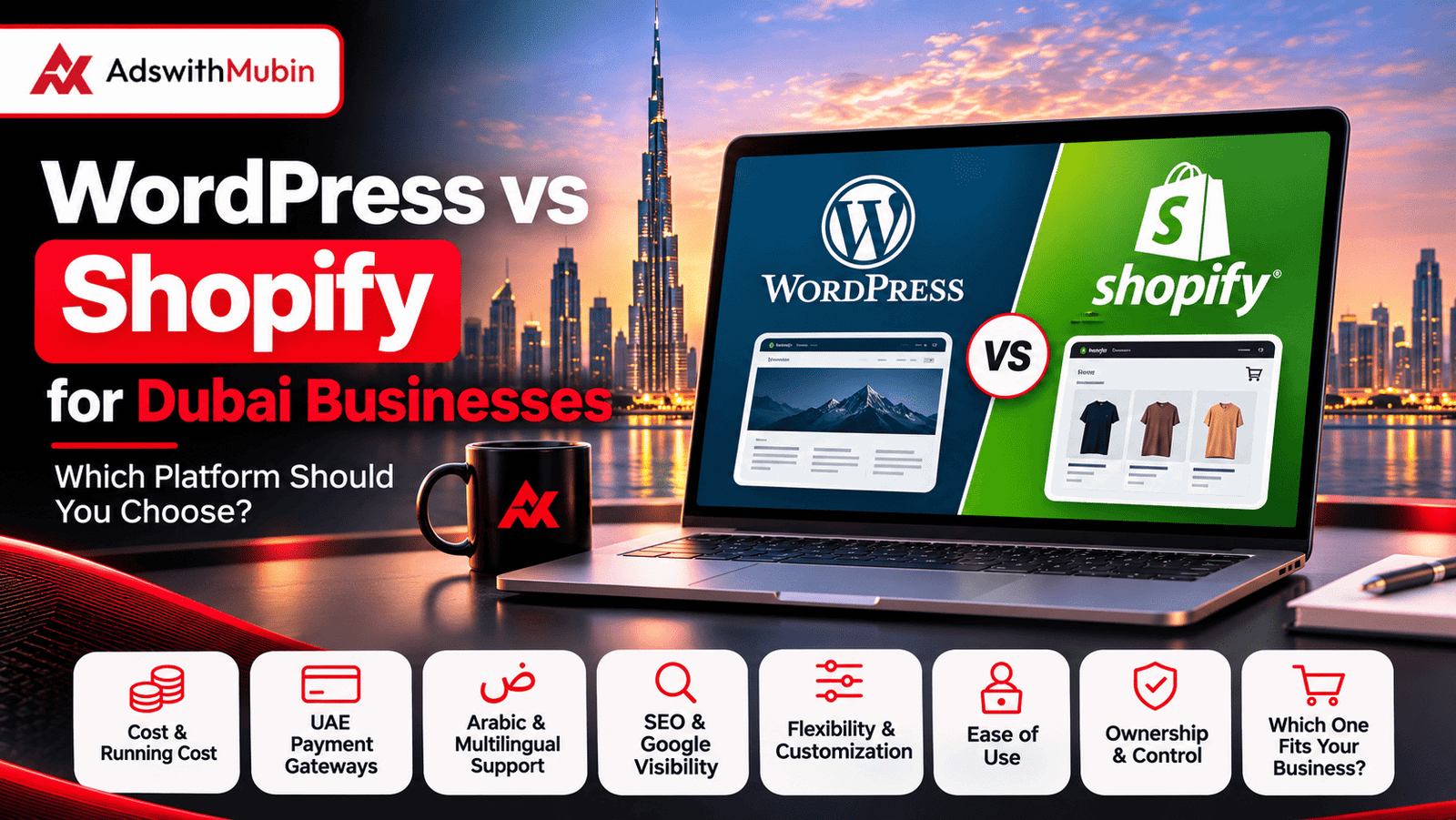
I build WordPress and WooCommerce websites for Dubai businesses, and I run the Google Ads, Meta Ads and SEO that send traffic to them. This guide compares WordPress vs Shopify for Dubai businesses on the points that actually affect your results: cost, payments, language, SEO, ownership and day-to-day use.
The Short Answer
| If you are… | Usually the better fit |
| A service business (clinic, garage, maintenance, consultancy, business setup) | WordPress |
| A business that relies on SEO and content to get leads | WordPress |
| A product brand that wants to sell online fast with minimal setup | Shopify |
| A store with many products and no technical person on the team | Shopify |
| A store that also needs lots of content, custom features or full control | WordPress + WooCommerce |
| A business mixing services, bookings and some products | WordPress |
If you only remember one thing: service business, lean WordPress. Pure product store, consider Shopify seriously.
What Each Platform Actually Is
WordPress is open-source software that runs a huge share of the world’s websites. You host it yourself (or with a hosting provider), and you can build almost anything: service pages, landing pages, blogs, booking systems, membership sites and online stores through the WooCommerce plugin.
Shopify is a hosted ecommerce platform. You pay a monthly subscription, and Shopify takes care of hosting, security and the core store features. You build your store using themes and apps from its marketplace.
That difference, self-hosted and flexible versus hosted and focused, drives almost every point below.
-
Cost: Upfront and Ongoing
WordPress
- The software is free
- You pay for hosting, domain, and any premium theme or plugins
- Development cost depends on how custom the site is
- No platform fee on your sales (your payment gateway still charges its own fees)
Shopify
- Monthly subscription, which increases on higher plans
- Many features come from paid apps, each with its own monthly fee
- Possible extra transaction fees depending on your plan and which payment provider you use
- Paid themes are a one-off cost
What surprises a lot of Dubai store owners is the app stack. A Shopify store that needs reviews, subscriptions, Arabic translation, advanced filters and WhatsApp integration can end up paying for several apps every month, on top of the plan.
WordPress isn’t free to run either. Hosting, security, updates and premium plugins all cost something. The difference is you control where that money goes. For current Shopify plan prices, check Shopify’s own pricing page, as they change.
My guide on website development cost in Dubai covers build costs in more detail.
-
Payment Gateways in the UAE
This is a big one for Dubai businesses, and worth checking before you choose.
Both platforms can work with popular UAE payment options, including card payment gateways and buy-now-pay-later services like Tabby and Tamara, usually through official plugins or apps. Cash on delivery is also easy to set up on both, and still matters for many UAE shoppers.
What to check before deciding:
- Is your preferred gateway (your bank’s gateway, Telr, Network International, Stripe and so on) supported on the platform?
- On Shopify, will using that gateway add extra transaction fees on your plan?
- Does it support Apple Pay and Google Pay?
- How long do payouts take to reach your UAE bank account?
Get the payment answer right first. It’s the one thing you can’t easily work around later.
-
Arabic and Multilingual Support
Many Dubai businesses need English and Arabic, and sometimes Russian or Hindi too.
WordPress handles multilingual sites well with plugins like WPML or Polylang, including right-to-left layouts for Arabic. You get separate URLs for each language, which is good for SEO in both.
Shopify supports multiple languages and has translation tools and apps. It works well for many stores, but full control over Arabic layouts and translated URLs can depend on your theme and apps.
If Arabic SEO is important to your business, test this properly with whichever platform and theme you’re considering.
-
SEO and Content
If organic traffic matters to your business, this section deserves the most attention.
WordPress was built as a content platform. You get full control over URLs, page structure, headings, schema markup, internal linking and blog content. With a plugin like Rank Math, technical SEO is straightforward. For service businesses that need separate pages for every service and area, WordPress is very hard to beat.
Shopify covers the SEO basics well, and many Shopify stores rank strongly. But it has some fixed URL structures (like /products/ and /collections/) and less flexibility for complex content. Its blog is functional but more limited.
For a product store, Shopify’s SEO is usually good enough. For a business that depends on content, service pages and local SEO to get leads, WordPress gives you more room to grow. My SEO cost guide explains what ongoing SEO usually involves.
-
Ownership and Control
WordPress: you own the website files and data, and you can move to any hosting provider whenever you like. You can change developers freely.
Shopify: you own your content and customer data, but the store runs on Shopify’s platform. If you stop paying, the store goes offline. Moving away later means rebuilding on another platform.
Neither is wrong. Some businesses happily trade control for convenience. Just make that choice knowingly.
-
Ease of Use
Shopify is easier for non-technical owners to run day to day. Adding products, managing orders and processing refunds is simple, and you don’t have to think about hosting, updates or security.
WordPress has more moving parts. Plugins and themes need regular updates, and someone needs to keep an eye on security and backups. Once it’s built properly, updating text, images and blog posts is easy, but it does need a bit more care in the background.
If you have no one to handle technical maintenance, budget for a care plan with WordPress, or lean towards Shopify.
-
Flexibility and Custom Features
WordPress can do almost anything: booking systems, quote forms, multi-step lead forms, membership areas, custom calculators, service area pages, CRM connections and more.
Shopify is excellent at selling products, but features beyond ecommerce often depend on apps, which can add cost and sometimes conflict with each other.
For Dubai service businesses that need bookings, WhatsApp lead capture and lots of landing pages, WordPress is usually the more natural fit.
-
Marketing and Ads
Both platforms connect with Google Ads, Meta Ads, Google Analytics and Tag Manager.
Shopify has very smooth product feed integration with Google Shopping and Meta catalogues, which is a real advantage for product stores running Shopping or Performance Max campaigns.
WordPress gives more control over landing pages for lead generation campaigns, which matters for service businesses running Google Ads and Meta lead campaigns. With WooCommerce, product feeds are also well supported through plugins.
If you plan to run ads, read my guides on Google Ads cost in Dubai and Meta Ads cost in Dubai.
WordPress vs Shopify: Side-by-Side
| Factor | WordPress (+ WooCommerce) | Shopify |
| Best for | Service businesses, content-led sites, custom stores | Product-focused online stores |
| Platform fee | None (you pay hosting) | Monthly subscription |
| Apps / plugins | Many free and paid plugins | Many paid apps with monthly fees |
| Transaction fees | Gateway fees only | Gateway fees, plus possible platform fees depending on setup |
| SEO control | Full control | Good basics, some fixed structures |
| Arabic / multilingual | Strong with plugins | Supported, depends on theme and apps |
| Ownership | You own and can move everything | Runs on Shopify’s platform |
| Maintenance | Needs updates and security care | Handled by Shopify |
| Ease of daily use | Easy once built | Very easy |
| Custom features | Almost unlimited | Mostly through apps |
So Which Should You Choose?
Choose WordPress if:
- You’re a service business that gets customers through enquiries, calls and WhatsApp
- SEO, content and local search are central to your growth
- You need custom features like bookings, quote forms or area pages
- You want full ownership and freedom to change developers or hosting
Choose Shopify if:
- You sell physical products and want to launch quickly
- You don’t have anyone to manage technical updates
- Your growth will come mainly from product ads and Shopping campaigns
- You value convenience over full control
Choose WordPress + WooCommerce if:
- You sell products but also need strong content, SEO and custom features
- You want an online store without monthly platform fees
- You’d rather own your store fully
Common Mistakes When Choosing a Platform
- Choosing based on what a friend or competitor uses, not your own needs
- Ignoring payment gateway support until after the build
- Underestimating Shopify app costs or WordPress maintenance
- Picking a platform without thinking about Arabic or multilingual needs
- Not planning for SEO before choosing
- Letting a developer choose the platform they always use, without explaining why
If you’re still comparing developers, my guide on how to choose a website developer in Dubai covers the questions to ask.
Frequently Asked Questions
Is WordPress or Shopify better for a small business in Dubai?
For service businesses, WordPress is usually the better choice because of its flexibility, SEO control and lead generation options. For small product-only stores, Shopify can be quicker and easier to run.
Is Shopify available in the UAE?
Yes, many UAE businesses run Shopify stores. Check which payment options and features are available for UAE businesses on your chosen plan before you commit.
Is WooCommerce cheaper than Shopify?
WooCommerce has no platform subscription, so ongoing costs can be lower. But you’ll pay for hosting, maintenance and any premium plugins. The total depends on your store’s size and needs.
Can I move from Shopify to WordPress later?
Yes, products, customers and content can be migrated. But it takes planning, and URLs need proper redirects to protect your Google rankings.
Which platform is better for SEO?
Both can rank well. WordPress gives more control over structure and content, which helps service businesses and content-heavy sites. Shopify’s SEO is solid for most product stores.
Can WordPress handle a large online store?
Yes, with good hosting and a properly built WooCommerce setup. Very large or fast-growing stores need more attention to performance either way.
Not Sure Which Platform Fits Your Business?
The right platform depends on what you sell, how customers find you and who will look after the site.
Send me a message with what your business does and what you need the website to do. I’ll tell you which platform I’d recommend and why, and what it would cost to build, whether you work with me or not.
Explore my website development services in Dubai
Call / WhatsApp: +971 52 770 7860
Email: info@adswithmubin.com
Website: https://adswithmubin.com/